Hahnemann's concept :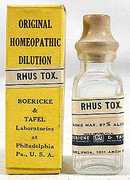
Samuel Hahnemann conceived of homeopathy while translating a medical treatise by Scottish physician and chemist William Cullen into German.Being sceptical of Cullen’s theory concerning cinchona’s action in malaria, Hahnemann ingested some of the bark specifically to see if it cured fever "by virtue of its effect of strengthening the stomach". Upon ingesting the bark, he noticed few stomach symptoms, but did experience fever, shivering and joint pain, symptoms similar to some of the early symptoms of malaria, the disease that the bark was ordinarily used to treat. From this, Hahnemann came to believe that all effective drugs produce symptoms in healthy individuals similar to those of the diseases that they can treat. This later became known as the "law of similars", the most important concept of homeopathy.The term "homeopathy" was coined by Hahnemann and first appeared in print in 1807, although he began outlining his theories of "medical similars" in a series of articles and monographs in 1796.
Hahnemann began to test what effects substances produced in humans, a procedure which would later become known as "proving".These time-consuming tests required subjects to clearly record all of their symptoms as well as the ancillary conditions under which they appeared. Hahnemann saw this data as a way of identifying substances suitable for the treatment of particular diseases. The first collection of provings was published in 1805 and a second collection of 65 remedies appeared in his book, Materia Medica Pura, in 1810. Hahnemann believed that large doses of drugs that caused similar symptoms would only aggravate illness, and so he advocated extreme dilutions of the substances; he devised a technique for making dilutions that he believed would preserve a substance's therapeutic properties while removing its harmful effects, proposing that this process aroused and enhanced "spirit-like medicinal powers held within a drug". He gathered and published a complete overview of his new medical system in his 1810 book, The Organon of the Healing Art, whose 6th edition, published in 1921, is still used by homeopaths today.
General philosophy :
Homeopathy is a vitalist philosophy in that it regards diseases and sickness to be caused by disturbances in a hypothetical vital force or life force in humans and that these disturbances manifest themselves as unique symptoms. Homeopathy contends that the vital force has the ability to react and adapt to internal and external causes, which homeopaths refer to as the "law of susceptibility". The law of susceptibility states that a negative state of mind can attract hypothetical disease entities called "miasms" to invade the body and produce symptoms of diseases. However, Hahnemann rejected the notion of a disease as a separate thing or invading entity and insisted that it was always part of the "living whole".
Hahnemann began to test what effects substances produced in humans, a procedure which would later become known as "proving".These time-consuming tests required subjects to clearly record all of their symptoms as well as the ancillary conditions under which they appeared. Hahnemann saw this data as a way of identifying substances suitable for the treatment of particular diseases. The first collection of provings was published in 1805 and a second collection of 65 remedies appeared in his book, Materia Medica Pura, in 1810. Hahnemann believed that large doses of drugs that caused similar symptoms would only aggravate illness, and so he advocated extreme dilutions of the substances; he devised a technique for making dilutions that he believed would preserve a substance's therapeutic properties while removing its harmful effects, proposing that this process aroused and enhanced "spirit-like medicinal powers held within a drug". He gathered and published a complete overview of his new medical system in his 1810 book, The Organon of the Healing Art, whose 6th edition, published in 1921, is still used by homeopaths today.
General philosophy :
Homeopathy is a vitalist philosophy in that it regards diseases and sickness to be caused by disturbances in a hypothetical vital force or life force in humans and that these disturbances manifest themselves as unique symptoms. Homeopathy contends that the vital force has the ability to react and adapt to internal and external causes, which homeopaths refer to as the "law of susceptibility". The law of susceptibility states that a negative state of mind can attract hypothetical disease entities called "miasms" to invade the body and produce symptoms of diseases. However, Hahnemann rejected the notion of a disease as a separate thing or invading entity and insisted that it was always part of the "living whole".
Law of similars :
Hahnemann observed from his experiments with cinchona bark, used as a treatment for malaria, that the effects he experienced from ingesting the bark were similar to the symptoms of malaria. He therefore reasoned that cure proceeds through similarity, and that treatments must be able to produce symptoms in healthy individuals similar to those of the disease being treated. Through further experiments with other substances, Hahnemann conceived of the "law of similars", otherwise known as "like cures like" (Latin: similia similibus curentur) as a fundamental healing principle. He believed that by inducing a disease through use of drugs, the artificial symptoms empowered the vital force to neutralise and expel the original disease and that this artificial disturbance would naturally subside when the dosing ceased .
Miasms and disease:
Hahnemann found as early as 1816 that the patients he treated through homeopathy still suffered from chronic diseases that he was unable to cure. In 1828,he introduced the concept of miasms, which he regarded as underlying causes for many known diseases. A miasm is often defined by homeopaths as an imputed "peculiar morbid derangement of our vital force". Hahnemann associated each miasm with specific diseases, with each miasm seen as the root cause of several diseases. According to Hahnemann, initial exposure to miasms causes local symptoms, such as skin or venereal diseases, but if these symptoms are suppressed by medication, the cause goes deeper and begins to manifest itself .
